Thursday, May 31, 2007

Restore Fire-Resistant Longleaf Pines, Get Clean Energy

One way to beat the large fires scorching drought-stricken Florida: restore the state's native Longleaf pine forests. But large-scale restoration of these forests―in actuality open savannas characterized by widely spaced stands of Longleaf pine trees―would require the removal of any existing vegetation, including established trees. Would this be the environmental equivalent of robbing from Peter to pay Paul?
 
Jack Putz, a botany professor at the University of Florida (UF), asserts that fires have been so intense of late because of Florida's too-dense forests, filled with hardwoods such as laurel oaks, water oaks, and sweet gums. Because fire-suppression have only encouraged the growth of these hardwoods, the native Longleaf pine that was common when Florida was first populated have largely disappeared. Only 3 percent remains of the original Longleaf pine ecosystem, which spanned more than 91 million acres across the southern United States.
 
The result: Fires raging out of control as dense stands of hardwoods and pines burn intensely all the way to to their crowns. Widely spaced stands of Longleaf pines, on the other hand, burn slowly, with low fires that creep along the grass and brush at one- to three-year intervals. Slow hand, easy touch, and all that.
 
While Florida foresters have been actively restoring Longleaf pine forests in small selected areas throughout the Southeast for a while, the catch is that the removal of a site's hardwood trees is expensive, energy intensive, and polluting. Make that really polluting.
 
But Putz argues that felled hardwood trees could be used as fuel to generate electricity.
 
In a press release from UF:
 
    The hardwoods that invade after fire suppression could be burned in generators, a practice that already occurs at some sawmills, or converted to cellulose-based ethanol once that technology improves in the future. Such energy is "greenhouse gas neutral" because it emits no carbon from fossil sources.
 
Some landowners have taken to grinding up unwanted hardwoods into fuel chips, which are then burned, usually at sawmills, to generate electricity. This electricity is sometimes fed back into the grid when the sawmill is idle.
 
Putz and Brian Condon, a student in UF's food and resource economics department, analyzed 13 North Florida restoration projects producing such fuel chips with electricity generation in mind. They discovered that the amount of carbon harvested in the chips greatly outweighed what was consumed in the diesel used during harvest and transport. In other words, the process offsets carbon.
 
"People are looking for solutions and there are not many around, other than consuming less energy," Putz said. "But here's a solution to three problems: restoring our native Longleaf pine savannas, boosting clean energy and reducing fire risk." :: University of Florida
 

Wednesday, May 30, 2007

New Hubble Photograph Shows Stunning Details in Spiral Galaxy M81 --CfA Press Release

Honolulu, HI - Today, astronomers unveiled the sharpest photograph ever taken of the nearby spiral galaxy Messier 81. The image from NASA's Hubble Space Telescope shows stunning detail in a galaxy that resembles the Milky Way in many ways.

"The amazing detail in this image took our breath away," said astronomer Andreas Zezas of the Harvard-Smithsonian Center for Astrophysics (CfA). "We can see individual stars like tiny grains of sand."

Zezas presented the new photograph at a press conference at the 210th meeting of the American Astronomical Society.

Eighty years ago, astronomer Edwin Hubble was the first to resolve stars in the Andromeda galaxy, proving that it was a distinct galaxy separate from the Milky Way. Now, the space telescope named for Hubble has repeated his achievement with a galaxy more than five times farther away.

M81 is one of the brightest galaxies that can be seen from Earth. It is high in the northern sky in the circumpolar constellation Ursa Major, the Great Bear. At an apparent magnitude of 6.8, it is easily visible in binoculars or a small telescope. The galaxy's angular size on the sky is about the same as that of the Full Moon. Photographing such a large area required the equivalent of 2.5 days of HST time.

This beautiful galaxy is tilted at an oblique angle to our line of sight, giving a "bird's-eye view" of the spiral structure. The galaxy is similar to our Milky Way, but our favorable view provides a better picture of the typical architecture of spiral galaxies. Though the galaxy is 11.6 million light-years away, The Hubble Space Telescope's view is so sharp that it can resolve individual stars, along with open star clusters, globular star clusters, and even glowing regions of fluorescent gas.

"The view we have of M81 is similar to what an astronomer in Andromeda would see if they looked at the Milky Way," explained Zezas.

The spiral arms, which wind all the way down into the nucleus, are made up of young, bluish, hot stars formed in the past few million years. They also host a population of stars formed in an episode of star formation that started about 600 million years ago. The greenish regions are dense areas of bright star formation. The ultraviolet light from hot young stars are fluorescing the surrounding clouds of hydrogen gas. A number of sinuous dust lanes also wind all the way into the nucleus of M81.

"The presence of dust lanes shows that star formation is happening all the way down to the nucleus," said Zezas.

M81 may be undergoing a surge of star formation along the spiral arms due to a close encounter it may have had with its nearby spiral galaxy NGC 3077 and a nearby starburst galaxy (M82) about 300 million years ago. Astronomers plan to use the Hubble image to study the star formation history of the galaxy and how this history relates to the neutron stars and black holes seen in X-ray observations of M81 with NASA's Chandra X-ray Observatory.

This project is part of a larger, in-depth investigation of M81 using the Spitzer Space Telescope and the Galaxy Evolution Explorer (GALEX) in addition to Hubble.

"It's absolutely amazing to be able to study star formation in this galaxy with three superb space telescopes in ways we could never achieve from the ground," said John Huchra (CfA), who also is working on the M81 project.

The Hubble data was taken with the Advanced Camera for Surveys in 2004 through 2006. This color composite was assembled from images taken in blue, visible, and infrared light.

Additional images can be found at http://hubblesite.org/newscenter/archive/releases/2007/19/.

Scientists involved in this project include: A. Zezas, K. Gazeas, G. Fabbiano, A. Prestwich, M. Garcia, and J. Nantais (CfA), J. Gallagher (University of Wisconsin, Madison), J. Miller (University of Michigan), P. Kaaret (University of Iowa), V. Kalogera (Northwestern University), M. Ward (University of Durham), J. Brodie and J. Strader (Lick Observatory), and A. King (University of Leicester).

The Hubble Space Telescope is a project of international cooperation between NASA and the European Space Agency. The Space Telescope Science Institute conducts Hubble science operations. The institute is operated for NASA by the Association of Universities for Research in Astronomy, Inc., Washington.

Headquartered in Cambridge, Mass., the Harvard-Smithsonian Center for Astrophysics (CfA) is a joint collaboration between the Smithsonian Astrophysical Observatory and the Harvard College Observatory. CfA scientists, organized into six research divisions, study the origin, evolution and ultimate fate of the universe.

For more information, contact:

David A. Aguilar
Director of Public Affairs
Harvard-Smithsonian Center for Astrophysics
617-495-7462
daguilar@cfa.harvard.edu

Christine Pulliam
Public Affairs Specialist
Harvard-Smithsonian Center for Astrophysics
617-495-7463
cpulliam@cfa.harvard.edu

Userplane Launches Revenue Sharing Program

Web messaging services company Userplane has launched a new revenue-sharing program that brings monetization to online instant messaging and web chat
 
Userplane Money serves ads in instant messaging, web chat and other widgets. The new program is said to be the first of its kind amongst community platforms.
 
Userplane CEO Mike Jones sees what he calls the "Platform Web" as the next area of online monetization. " Userplane Money offers rich application experiences that increase user engagement on our clients' websites, and provide them with a new revenue channel and increased site usage".
 
Userplane was acquired by AOL in August 2006 and the new program is linked into AOL's larger advertising strategy. "AOL has a rich offering of ad solutions for advertisers, including internal advertising within the AOL network, 3rd party publisher relationships through advertising.com, and a longtail ad offering through the Userplane network" said Jones."Userplane Money grows the Userplane longtail ad network and gives advertisers access to users and inventory they had not had access to previously on smaller, targeted niche web communities".
 
Jones sees Userplane Money as a way to reward users and position the service as a key revenue driver for smaller up and coming web communities.
 
The combination of Userplane's technology with a revenue-sharing program is sure to drive future growth to what is already a very smart offering.

Microsoft Announces Surface Computer

At the D: All Things Digital conference Wednesday, Microsoft CEO Steve Ballmer will unveil Microsoft Surface, the first in a new category of surface computing products from Microsoft that will "break down traditional barriers between people and technology".
 
A Surface computer is able to recognize physical objects from a paintbrush to a cell phone and allows hands-on, direct control of content such as photos, music and maps. Surface turns an ordinary tabletop into a dynamic surface that provides interaction with all forms of digital content through natural gestures, touch and physical objects.
 
The new product is aimed directly at hotels, retail establishments, restaurants and public entertainment venues and should be commercially available towards the end of the year.
 
It's an interesting product in that it's completely out of left field. Microsoft gives examples of ordering a beverage during a meal with just the tap of a finger and quickly browsing through music and dragging favorite songs onto a personal playlist by moving a finger across the screen. Build this into a bar and you'd get one-touch beer service although I'm not sure if they've found a way to work out when your beer glass is empty so replenishment becomes automatic, maybe in a later version.
 
The practical uses for Surface at the point of sale are broad. This is touch screen point of sale technology at a new level.
 
Initial launch partners include Harrah's Entertainment, Starwood Hotels and T-Mobile.

Tuesday, May 29, 2007

Halo 3 Cinematics To Be Great Improvements on Halo 2's

1up is reporting that Bungie has admitted to not having the time to do cinematics right for the best-selling Halo 2. Along with statements they made earlier this year about flaws in Halo 2's multiplayer, the folks at Bungie seem quite willing to own up to previous mistakes. Their call to arms this time: everything will be better. "With Halo 3, they have artists and designers who've worked on epic Hollywood projects like The Lord of the Rings and King Kong, not to mention a former Industrial Lights & Magic guy (read: Star Wars) working out the details on an 'amazing space battle ... there's a bigger team, a team that has had the final cinematic script for much longer, and now has access to vastly more tools, resources and technology than ever before. These range from new tools for rigging facial animation, to better lighting and camera controls. Most of the improvements are a solid blend of technology and manpower this time around, and we hope the fruits of that labor end up as succulent as they look now.'"

Inside Bungie - Living The Spartan Life

Straight from the latest issue of Edge, a great feature all about the life inside Bungie studios. The article gets into a good bit of detail on the mindset of this insular part of Microsoft's development network. Interviewed developers discuss what it is like working for Microsoft, and how hard it is not to be hard on themselves. Specifically, the developers have some surprisingly harsh criticism of their own opus - Halo 2. From the article, comments by technical lead Chris Butcher: "One of the things that stuns me when I think about it, and I can't believe this is true - we had [no time to polish] for Halo 2. Take that polish period and completely get rid of it. We miscalculated, we screwed up, we came down to the wire and we just lost all of that. So Halo 2 is far less than it could and should be in many ways because of that. It kills me to think of it. Even the multiplayer experience for Halo 2 is a pale shadow of what it could and should have been if we had gotten the timing of our schedule right. It's astounding to me. I f***ing cannot play Halo 2 multiplayer. I cannot do it. And that's why I know Halo 3 is going to be so much better."

Halo 3 Beta Impressions

Yesterday in New York City Microsoft held an invite-only preview of the Halo 3 Beta, and passed out early Beta keys to a group of game journalists. The result is a barrage of coverage about this most-anticipated title. Notable features beyond basic previews include Dan Hsu's take on the game, Dean Takahashi's 'I got my butt kicked' perspective, the San Jose Merc's interview with Bungie Community Lead Brian Jarrad, CVG's hosting of the official Beta Movie, and Joystiq's interview with Frank O'Connor, Bungie's writing lead. From the 1up preview: "It's unmistakably Halo gameplay, despite the rearranged controls (which feel natural after 10 minutes), and all of the additions fit perfectly into the multiplayer universe we've come to love. The interface has been overhauled and is even easier to use, and you now have such niceties as being able to change your control layout at any point on any screen. While the visuals are rich and beautiful, it's the audio that's really impressed us so far. The rumbling throttle of unleashing dual SMGs makes them feel incredibly powerful, and the Spartan Laser tearing past your head is as scary as you'd imagine. Audio cues are more important than ever, and the better your sound system the more next-gen this will feel."

Monday, May 28, 2007

The TechCrunch Quick Guide To GrandCentral

We've followed new telephone management startup GrandCentral since it's debut in September 2006. The company has deservedly received a lot of blogger and mainstream press: Tim O'Reilly said "The Web 2.0 Address Book May Have Arrived" when talking about it, and the New York Times did a long overview article in March.
 
The basic idea around GrandCentral is "one phone number for all your phones, for life." As we change jobs, homes and cell phones, there are a lot of phone numbers to keep track of, and keeping everyone up to date with your most recent phone numbers is a real cost. If you use GrandCentral you can give out a single phone number. What happens when that person calls that number depends on his/her relationship to you, and what you are doing at the time.
 
Our follow up coverage wasn't entirely positive. In late March we noted some hiccups with the service that led some beta testers to abandon it. But we've continued to use the service, covered its mobile site launch, and in general I think it is one of the standout startups of the last twelve months.
 
For those of you who aren't using it yet, I've put together my user notes over the last couple of months. There are a lot of features to get used to, and to get the most out of the service you should be aware of at least some of them.
 
This is a service to keep an eye on - They are certainly still working out some of the bugs, but the GrandCentral team has created a truly useful service with less than $6 million in capital. I would not be surprised, given this acquisition climate, to see someone pick them up in the near term.
 
Here's the TechCrunch Quick Guide to GrandCentral:
 
Getting Started
 
GrandCentral will be free for light users, but most users will end up paying $15/month for the service once a lot of people start using it as the primary way to contact you by phone.
 
The center of the Grand Central universe is your Grand Central phone number. This is (theortically) the last phone number you will ever give out, so picking one that you like is important. The GC registration process begins by picking an area code or U.S. state. Once you've done that, GC will show you a number of available phone numbers. If you want to see if any of the numbers spell anything interesting or memorable, check out this site, which will show you various words made from the numbers.
 
After you've chosen your GC phone number you go through a standard registration process and then tell GC your home, work and cell phone numbers. When someone calls your GC phone number, GC will ring your real phones based on rules you set.
 
The Basics
 
A big hurdle to using GC is the fact that no one knows it's your new phone number, and they keep calling your old number. To get the maximum benefit from the service you need to route as many calls through it as possible. The only way to do that is to let your contacts know that your new GC number is the best way to reach you. Before you send out a mass email and reprint a thousand business cards, though, make sure you plan on sticking with the service.
 
The next thing you need to do is record a greeting that people will hear when they call the number. You can customize greetings by specific callers or groups, so business callers can get one message, and friends can get another.
 
You'll also want to import your address book. Supported formats are Outlook/Outlook Express, Yahoo, Gmail, vCards and CSV files. You can also add contacts manually.
 
Then you set up rules for phone calls. Have business contacts always ring your cell phone. Have family ring all of your phones. Friends go to your home number. Or whatever. You can also set certain people to go right to voicemail if you never want to talk to them directly.
 
You can also temporarily set all of your calls to go immediately to voicemail or to forward to another phone (this is great if you are out of town).
 
Handling Calls and Voicemails
 
Once you start taking calls you will fall in love with the service.
 
When someone calls your number they are asked to record their name unless they are recognized as a contact by caller ID. Your phones then start ringing based on the rules you've set. When you answer, the GC automated system tells you who is calling and asks you what you want to do with it. You can either accept it, send it to voicemail, send it to voicemail and listen in, or accept it and record the call. Hitting "4″ during a call turns recording on or off. If you are listening in on a voicemail, just hit "*" and you can jump into the call.
 
Voicemails are sent to your inbox - they can be reviewed by calling in or via your computer (see "mobile" below as well). All voicemails can be forwarded to others, or you can request an embed code to place it on a website.
 
GrandCentral has said that they will soon be releasing a feature that automatically transcribes voicemails into text and will deliver them to you via email or SMS.
 
Mobile Access
 
GrandCentral recently released a Mobile product. Visit grandcentral.com/mobile via a mobile browser and get a stripped down version of your inbox and other core features.
 
You can listen to and administer your voicemails directly from this mobile web page, without dialing into your voicemail system directly.
 
Advanced Features
 
GrandCentral also has a number of advanced features that will appeal to some users.
 
    * CallSwitch: Hit "*" while talking and your other phones will ring. You can then answer any of them and the call will transfer over
    * WebCall: embed a call button on your website and let people call you (the caller will not see your phone number)
    * Gizmo: GC will use your Gizmo ID as a forwarding phone number - get calls on your computer (great when traveling abroad)


Sunday, May 27, 2007

Int'l. Space Development con: Glenn Reynolds liveblogs it

I haven't been to an International Space Development Conference in years. Things have changed a bit, and that was probably more apparent to me than to people who have been going every year. But lots of people were remarking on some changes.

Most notably, the character of the attendees has changed. There's less of a science-fiction-convention feel, as more of the people attending are actually making their living in the space biz, and particularly the commercial space biz. One of the people I was talking to last night was noting that there were a lot more attractive women than in the past, a change she put down to the presence of a lot more "good-looking men with money."

There's something to that, and Alan Boyle has a post on the entrepreneurial activity at the conference. I have to say that it's the first time I've seen Brioni suits at an ISDC -- as happened a few years ago with the nanotech conferences I attend, suddenly there's a sizable contingent of venture capitalists, investment bankers, big-firm lawyers, and the like. There's not a space bubble yet, but a guy I spoke with who knows a lot said that "the bubble's scheduled for two years from now," and that seems about right.

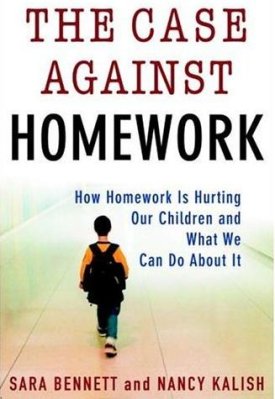
Homework sucks: The case against homework


Sara Bennett and Nancy Kalish 2006 book "The Case Against Homework" is a fine and frightening explosion of the homework myth: that giving kids homework improves their educational outcome. The authors start by tracing the explosion in homework since the eighties, and especially since the advent of the ill-starred No Child Left Behind regime, which has teachers drilling, drilling, drilling their kids on math and reading to the exclusion of all else.

Kindergarten kids are assigned homework. Kids get homework over the weekend. Over vacations. When they're away sick for a day.

What's more, all the credible research on homework suggests that for younger kids, homework has no connection with positive learning outcomes, and for older kids, the benefits of homework level off sharply after the first couple assignments.

Not that most teachers would know this -- homework theory and design isn't on the curriculum at most teachers' colleges, and most teachers surveyed report that they have never received any training on designing and assessing homework.

The book is composed of equal measures of interviews with kids, parents and teachers; hard research numbers from respected institutions; and strategies for convincing your kids' teachers to ease back on homework.

One thing the authors keep coming back to is the way that excessive homework eats into kids' playtime and family time, stressing them out, contributing to sedentary obesity, and depriving them of a childhood's measure of doing nothing, daydreaming and thinking. They quote ten-year-olds like Sophia from Brooklyn, saying things like "I have to rush, rush, rush, rush, rush, rush through my day, actually through my seven days, and that's seven days wasted in my life."

No Child Left Behind has to shoulder some of the blame here. No Child Left Behind and standardized testing not only turns your child into a slave to her test-scores, but they can even affect your property values: a school with low test-scores brings down the neighborhood property values. That means that whatever your approach to your kids, the chances are that the other parents in your neighborhood are busting their asses to get their kids great test scores, drilling them, sending them to tutors, helping them with assignments that they were meant to complete themselves. If you don't do the same, your kids will suffer by comparison.

The authors report on an elementary school in North Carolina where at least twenty standardized test books have to be replaced after their use because the stressed out elementary school kids working to them have vomited on them.

The stories go on and on, and just when you're ready to throw in the towel and send your kids into the woods to be raised by wolves, the authors supply several long chapters of strategies and sample dialogs for convincing your kids' teachers to ease off on homework, for changing the homework policies in your school district and for rallying other parents to their cause.

They're not whistling Dixie, either: the authors have gone through this themselves, challenging and changing the homework policies in their kids' school districts. The last section of the book is an activist guide and a postmortem of the strategies they employed. One of the authors, Sara Bennett, is a celebrated civil rights lawyer; the other, Nancy Kalish, is a famous editor and writer of material for parents, especially mothers. One imagines that their school board didn't know what hit them.

I was lucky enough to attend excellent, publicly funded alternative schools through my educational career. We had homework, but we were also given a lot of time for free play, and a lot of free rein to choose our subjects and design our curriculum -- I remember spending half of the fourth grade working my way through two or three math textbooks and the other half designing and writing a parody of MAD Magazine, to the exclusion of all other work. The next grade I followed the class for most of the semester, except when I didn't. In high-school, I took a year off, moved to a little house in Mexico, and wrote stories. All of this stuff contributed more to my learning than any amount of worksheets and homework ever could have.

Creation Museum opens Monday

Some silly creationists are finally opening their wacky $27 million Creation Museum on Monday in Petersburg, Kentucky. The slogan on the museum's site? "Prepare to believe." From Reuters:
Here exhibits show the Grand Canyon took just days to form during Noah's flood, dinosaurs coexisted with humans and had a place on Noah's Ark, and Cain married his sister to people the earth, among other Biblical wonders.

Scientists, secularists and moderate Christians have pledged to protest the museum's public opening on Monday. An airplane trailing a "Thou Shalt Not Lie" banner buzzed overhead during the museum's opening news conference....

A Gallup poll last year showed almost half of Americans believe that humans did not evolve but were created by God in their present form within the last 10,000 years.

Three of 10 Republican presidential candidates said in a recent debate that they did not believe in evolution.

Harley Hearse


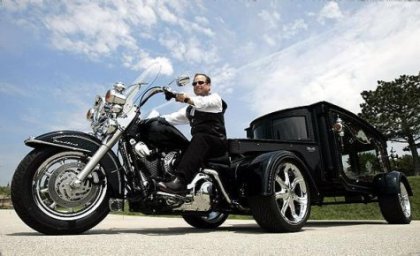
The latest thing in "experience" funerals is a Harley Hearse from Milwaukee's Krause Funeral Home -- it joins a host of specialty funeral options available around the world, including "farmers being pulled to their rest by John Deere tractors" and "cremation urns that look like tear-drop motorcycle gas tanks।"
Now, he has what he prefers to call "the Krause Funeral Home Motorcycle Hearse" out of sensitivity to local manufacturing icon Harley-Davidson Inc., which carefully guards its famous brand.

"For so long, funerals have been so reactive," Krause said. "I think that's part of the reason that people don't like funerals - that they've been so traditional. . . . If we can offer people more options and be more creative in the way we say goodbye, it will certainly broaden our clientele."


Detailed anatomical t-shirts


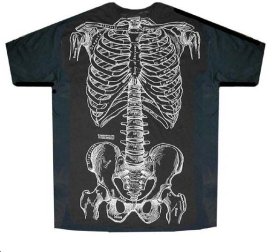
Medical illustrator Leslie Arwin's Skeletees feature highly detailed, stark anatomical drawings of the bones, muscles, nerves and digestive tract, printed on the front and back. I picked up a skeleton shirt today and I'm delighted with it -- it's a great, thick, high-quality tee with a nice cut and the design is wonderful.

Saturday, May 26, 2007

Feds Give Warning on Contact Lens Solution

ATLANTA (May 26) - Government officials are warning people to throw away a contact lens solution after an investigation linked it to a rare eye infection.

The warning concerns AMO Complete Moisture Plus Multi-Purpose Solution, used for cleaning and storing soft contact lenses, said a spokeswoman for the U.S. Centers for Disease Control and Prevention.

The solution seems to be a factor cases of Acanthamoeba keratitis, a painful eye infection that can lead to permanent vision loss or blindness.

The CDC and the U.S. Food and Drug Administration are investigating 138 confirmed cases since January 2005.

The solution is made by Advanced Medical Optics Inc., a publicly traded company based in Santa Ana, Calif. The company issued a statement Friday night saying it was "immediately and voluntarily recalling" the solution.

"There is no evidence to suggest that today's voluntary recall is related to a product contamination issue and this does not impact any of AMO's other contact lens care products, including our family of hydrogen peroxide disinfecting solutions," the statement said.

CDC officials said people should discard the solution, throw out their current contact lenses and toss the lens storage case. All of them may harbor the infecting amoeba, said Michael Beach, team leader in the CDC's division of parasitic diseases.

An estimated 85 percent of U.S. cases of Acanthamoeba keratitis occur in contact lens users, but it's extremely unusual - the estimated prevalence is one to two cases per 1 million contact lens wearers. Contact lens wearers who practice proper lens care and people who don't wear contact lenses can still develop the infection.

It's hard to diagnose and treat - and some of the drugs used to fight the infection are available only overseas or from compounding pharmacies.

Doctors first suspected a problem in 2004, when a University of Illinois-Chicago ophthalmologist, Dr. Elmer Tu, noticed more than a dozen cases of the infection. Normally, he might see only one or two in a year, Tu said.

UIC doctors saw 35 patients with the condition from May 2003 through September 2006. About 55 percent used the Advanced Medical Optics product exclusively, Tu said.

UIC investigators think the infection is not originating in the manufacturing process, but that the cleaning solution is not protecting people from the infection, which they get in their eyes through showering or swimming, Tu said.

The amoeba that causes the infection is naturally present in soil and water. Wearing contact lenses while swimming or in the hot tub appears to increase the risk of infection.

The cases were reported to the Illinois state health department, which notified the CDC. A CDC investigation in about 35 states led to Friday's announcement.

The company statement said consumers who believe they are in possession of the recalled product should discontinue use immediately and call 1-888-899-9183. The company said it was contacting retailers, customers and distributors regarding return and replacement instructions.

The solution is not marketed to protect against the amoeba. But "it's supposed to be free of any type of microorganisms. It's not supposed to result in anyone getting an infection," said Julie Zawisza, an FDA spokeswoman.

The FDA will take information from the CDC investigation and try to discern what about the solution - or how people were using it - could be responsible for the infection cases, she added.

Health officials have interviewed 46 patients so far. Of those, 36 wore contact lenses and used some form of solution, and 21 used the Advanced Medical Optics solution within a month of onset of symptoms, Beach said. It was a strong enough association to cause health officials to issue Friday's warning, Beach said.

Dozens of cases of this rare condition can be significant, eye experts said.

"It's a large number if it's happening to you. It's a large number if there is a little pocket of it. It's not a large number if you consider there are 35 million contact lens wearers in the United States," said Dr. William Ehlers, a University of Connecticut Health Center ophthalmologist.

The investigation is the second into eye infections associated with contact lens solution undertaken by the CDC and FDA in the past year. In 2006, a Bausch & Lomb multipurpose contact lens solution was linked to a fungal eye infection called Fusarium.

This week, Advanced Medical Optics disclosed it was considering making a bid to buy Bausch & Lomb, its eye-care products rival.

Associated Press writer Andrew Bridges contributed to this report from Washington.


Study Finds 90% of Handset Owners Believe iPhone Hype

A study from Strategy Analytics has found that 90 percent of handset owners rate Apple's iPhone as being superior to existing mobile phones. This despite the rather pertinent facts that the iPhone has not yet gone on sale and none of those questioned would have used an iPhone.
 
The "Consumer Reactions to the Apple iPhone" study explored the appeal of iPhone features, developed comparisons with current products and investigated the nature of the iPhone experience. 90 percent of respondents gave the iPhone higher marks than their own handset and over 40 percent of respondents rated the iPhone as being much better across key functional categories, including music player, web browsing, voice mail, and phone call management.
 
The study found that whilst consumers are definitely buying the iPhone hype, price may be the iPhone's undoing. "While the iPhone "Wow" factor is impressive, our user panel indicated that challenges in pricing and positioning may act as a barrier to mass-market success," said Kevin Nolan, Director of User Experience Research at Strategy Analytics.

coRank: Build Your Own Digg Clone

If imitation is the sincerest form of flattery Digg would be at the top of the heap. The site that popularized social news has been copied, cloned and even spawned Pligg, an open source Digg style script.
 
If Pligg opened up Digg style clones to site hosts and developers, coRank takes the concept to the mass market; users who either can't or don't want to host Pligg on their own domain. coRank is to Digg clones what Blogger once was for blogging.
 
coRank has evolved from its earlier incarnation as a stand alone Digg clone. The new coRank is now a fully customizable hosted social voting platform. Users can set up social news sites through easy to use menu options without the need to edit code. Like Blogger there is a range of templates available, including one that looks just like Digg. The options are surprisingly broad. Users can customize everything from the name of voting members through to the names given to the actual voting system. Everything from user banning through to privacy options and user statistics has been included.
 
Although the entire morality of an army of Digg clones may be a passionate topic for debate, there's little doubt that social news continues to grow. Ethics aside coRank is a notable point in the progression of social news development. In time coRank is an idea that is sure to be cloned itself.

Last.FM Too Slow: Users Create Their Own Facebook Application

Last.fm is a seriously popular music service (we've dubbed it a viral machine). So users are wondering why they are yet to release a Facebook application - competitors like iLike and MOG are the first and fifth most popular applications, respectively.
 
The Last.fm forums are being lit up with user requests for integration. In early May, a staff member (flaneur) commented "we've started work on some cool ways to get your music taste from Last.fm on [Facebook]" in one of the early threads requesting integration. But a month later and a day after the official launch of Facebook Applications, nothing has been released.
 
Perhaps Last.fm sees Facebook as more of a competitor than a partner, or maybe they didn't realize just how important the new Facebook Developer Platform would be, in making the decision to hold off on creating a Facebook application. It doesn't really matter, though, because users are starting to take over. Jake Jarvis (who's also the founder of Middio) released his own Last.fm Facebook application earlier today. One of the more popular Last.fm features is that it tracks music you listen to on your computer and displays it on your profile. Jarvis' widget displays the last few songs you've listened to on Last.fm on your Facebook profile.
 
I added it to my profile and it works just fine. Read more about this on Jake Jarvis' blog. And thanks to Daryn Haynes for pointing this out in a comment to our post on iLike.
 
If you are a Facebook user, get the (unofficial) Last.fm application here. I'm looking forward to seeing how many users it has by tomorrow, and Last.fm's response.

Yahoo Experiments With Non-Yahoo Links On Home Page

The major Internet portals like Yahoo, AOL, MSN, Google, etc. do not place links on their home page that go anywhere except deeper into the properties. Advertising is generally the only exception.
 
So it surprised us when Yahoo contacted us earlier this week to say that they are testing outside links from their home page. The goal, they say, is to make Yahoo.com as relevant as possible to their. By linking to outside websites, their hope is that the relevance (perceived or actual) of the Yahoo portal will increase.
 
An article from CrunchGear was included in the test and was on the Yahoo home page for an hour or so yesterday. Other sites were linked to as well. The links were placed prominently at top center in the "featured" section.
 
Yahoo says that they will analyze the data and feedback from the test to determine whether or not they'll make this a permanent policy. My request is that they keep testing, and feel free to use our properties at any time.

Doctors deliver baby on Delta flight

ATLANTA - Two doctors on a Delta Air Lines flight from Germany delivered a baby in the aisle of the plane and resuscitated him when he wasn't breathing, officials said.
 

Delta Flight 131 to Atlanta was over the Washington area when a woman about 32 to 36 weeks ― or nine months ― pregnant went into labor Wednesday afternoon, prompting an emergency stop in Charlotte, N.C., about nine hours into the flight.
 
Though the baby boy wasn't breathing when he was born, he was "like a normal newborn" by Friday, one of the doctors who helped deliver him said.
 
The baby was born in front of the first seats after first class, one of the roomiest aisles in a plane. Using a stethoscope that was part of medical equipment onboard, the doctors realized the baby had a very slow or arrested heartbeat as the woman was in labor.
 
"Delivering a baby in an aisle of a plane isn't an easy thing to do," one of the doctors, Dr. Robert Vincent, a pediatric cardiologist with Children's Healthcare of Atlanta, said Friday. "I didn't think the child would survive."
 
Vincent worked with Dr. Dieter K. Gunkel, an adult cardiologist from Savannah, Ga., to deliver the baby. When he was born, he was blue and wasn't breathing or moving. Vincent started chest compressions and Gunkel did mouth-to-mouth breathing until the boy "pinked up," Vincent said.
 
"We were flying by the seat of our pants," Vincent said, adding that he didn't even realize baby was a boy until his birth was announced to applauding passengers.
 
Vincent said the baby weighed about seven pounds. His name wasn't available.
 
The mother, whose identity was not released, was taken to a hospital with the baby. About an hour after the emergency landing, the flight continued to Atlanta, officials said.
 
"It was a heroic effort by our flight attendant crew and our customers on board who were fortunately doctors," said Delta spokeswoman Betsy Talton.
 
Doctors usually discourage pregnant women to fly at the ninth month, but Talton said Delta has no policy to deny boarding. Other airlines, including Lufthansa and Northwest Airlines, require a medical certificate for women who are at the 36th week of pregnancy.

Friday, May 25, 2007

James Franco's height is 5 ft 10.75 in (180 cm)

Date of Birth:
19 April 1978, Palo Alto, California, USA more
Mini Biography:
Best known for his breakthrough starring role on "Freaks and Geeks" (1999), James... more
Trivia:
Auditioned for the role of Peter Parker in Spider-Man (2002), but was given... more
Awards:
Won Golden Globe. Another 1 win & 4 nominations more
Alternate Names:
James Edward Franco


James Franco has 1 in-development credit available on IMDbPro.com.
Actor:

* In Production
* 2000s
* 1990s

1. The Pineapple Express (2008) (post-production)
2. In the Valley of Elah (2007) (post-production) .... Sergeant Dan Carnelli

3. Spider-Man 3 (2007) (VG) (voice) .... New Goblin/Harry Osborn
4. Spider-Man 3 (2007) .... New Goblin/Harry Osborn
... aka Spider-Man 3: The IMAX Experience (USA: IMAX version)
5. Camille (2007) .... Silias
6. Finishing the Game (2007) .... Rob Force
7. An American Crime (2007) .... Dennis
8. Good Time Max (2007) .... Max
9. The Dead Girl (2006) .... Derek
10. Grasshopper (2006) .... Travis
11. The Wicker Man (2006) .... Bar Guy #1
12. Flyboys (2006) .... Blaine Rawlings
13. Annapolis (2006) .... Jake Huard
14. Tristan + Isolde (2006) .... Tristan
... aka Tristan & Isolde (USA: promotional title)
15. The Great Raid (2005) .... Captain Prince
16. The Ape (2005) .... Harry Walker
17. Fool's Gold (2005) .... Brent
18. Spider-Man 2 (2004) .... Harry Osborn
... aka Spider-Man 2.1 (USA: recut version)
... aka Spider-Man 2: The IMAX Experience (USA: IMAX version)
19. The Company (2003) .... Josh
... aka The Company - Das Ensemble (Germany)
20. The Car Kid (2003)
21. Mean People Suck (2003) .... Casey
22. City by the Sea (2002) .... Joey "Nova" LaMarca
... aka The Suspect (Philippines: English title)
23. Sonny (2002) .... Sonny Phillips
24. Blind Spot (2002/I) .... Danny
25. Mother Ghost (2002) .... Skateboarder guy
26. You Always Stalk the Ones You Love (2002)
27. Deuces Wild (2002) .... Tino
... aka Deuces Wild - Wild in den Stra?en (Germany)
28. Spider-Man (2002) .... Harry Osborn
29. James Dean (2001) (TV) .... James Dean/Narrator
30. Some Body (2001) (uncredited) .... Apartment Guy 3
31. "The X Files" .... Officer #2 (1 episode, 2001)
... aka The X-Files (USA)
- Surekill (2001) TV Episode .... Officer #2
32. "Freaks and Geeks" .... Daniel Desario (18 episodes, 1999-2000)
- Noshing and Moshing (2000) TV Episode .... Daniel Desario
- Dead Dogs and Gym Teachers (2000) TV Episode .... Daniel Desario
- Discos and Dragons (2000) TV Episode .... Daniel Desario
- Smooching and Mooching (2000) TV Episode .... Daniel Desario
- The Little Things (2000) TV Episode .... Daniel Desario
(13 more)
33. At Any Cost (2000) (TV) .... Mike
34. Whatever It Takes (2000) .... Chris Campbell
35. If Tomorrow Comes (2000) .... Devin

36. Never Been Kissed (1999) (as James Edward Franco) .... Jason Way
37. "Profiler" .... Nick (1 episode, 1999)
- Three Carat Crisis (1999) TV Episode .... Nick
38. To Serve and Protect (1999) (TV) .... Matt Carr
... aka Family Shield (USA)
39. "Pacific Blue" .... Brian (1 episode, 1997)
- Matters of the Heart (1997) TV Episode .... Brian

Director:

1. Good Time Max (2007)
2. The Ape (2005)
3. Fool's Gold (2005)

Writer:

1. Good Time Max (2007) (written by)
2. The Ape (2005) (written by)
3. Fool's Gold (2005) (play Emma) (play Fools Gold) (screenplay)

Producer:

1. The Ape (2005) (executive producer)

Self:

1. Spider-Man 3: UK Premiere Special (2007) (TV) .... Himself
2. "Corazón de..." .... Himself (2 episodes, 2007)
- Episode dated 26 April 2007 (2007) TV Episode .... Himself
- Episode dated 24 January 2006 (????) TV Episode .... Himself
3. "Xposé" .... Himself (1 episode, 2007)
- Episode #1.7 (2007) TV Episode .... Himself
4. The Holiday (2006) (uncredited) .... Himself
5. "Last Call with Carson Daly" .... Himself (1 episode, 2006)
- Episode dated 22 September 2006 (2006) TV Episode .... Himself
6. "Fuse Celebrity Playlist" .... Himself - Guest (1 episode, 2006)
- James Franco (2006) TV Episode .... Himself - Guest
7. "The Tony Danza Show" .... Himself (1 episode, 2006)
- Episode #2.81 (2006) TV Episode .... Himself
8. Making the Amazing (2004) (V) .... Himself
... aka Making the Amazing: Spider-Man 2 (USA)
... aka Making the Amazing: The Making of 'Spider-Man 2' (USA)
9. "The Early Show" .... Himself (3 episodes, 2002)
... aka The Saturday Early Show (USA: weekend title)
- Episode dated 31 December 2002 (2002) TV Episode .... Himself
- Episode dated 25 December 2002 (2002) TV Episode .... Himself
- Episode dated 21 December 2002 (2002) TV Episode .... Himself
10. "HBO First Look" .... Himself (1 episode, 2002)
- Spider-Man (2002) TV Episode .... Himself
11. Behind the Scenes: Spider-Man the Movie (2002) (TV) .... Himself
... aka Behind the Ultimate Spin (UK)

Thursday, May 24, 2007

Music playlist sharing site Webjay, acquired by Yahoo in January 2006, will be closing June 30 according to a message that has appeared on the site.

Music playlist sharing site Webjay, acquired by Yahoo in January 2006, will be closing June 30 according to a message that has appeared on the site.
 
The announcement gives Yahoo a hat trick of closure announcements for May, Webjay joining Yahoo Photos and Yahoo Auctions in the TechCrunch DeadPool.
 
Founded by Lucas Gonze, Webjay allowed users to publish music playlists on the web. Media players such as WinAmp and Windows Media Player could then be given a list of songs to play from locally stored music or via web streaming.
 
No reasons have been given for the closure. Alexa traffic data for Webjay shows a gradual decline in traffic from a peak in early 2006.

Compete API Open For Business

Web analytics startup Compete.com opened its API for public use today. Websites and applications can now access Compete's data and incorporate it into their own products.
 
This is timely for the company, which competes directly with Amazon's Alexa. Recenty, Statsaholic has been in a very public dispute with Alexa over use of its data, with both sides looking bad. That dispute recently went to litigation. As some services shy away from Alexa, either due to public perception or inflexibility over the Alexa APIs, Compete could grab additional market share.
 
Compete is using Mashery to handle the logistics and distribution of its API. We wrote about Mashery when they launched late last year. Our previous coverage of Compete is here.

Sequoia Leads Trulia’s $10 Million Series C

Real estate search engine Trulia joins an elite Silicon Valley Club today with the announcement of $10m Series C funding in a round headed by Sequoia Capital.
 
Trulia moved out of beta earlier this month and launched a number of new features.
 
Sequoia is joined in the funding round by previous investors Accel and Fayez Sarofim & Co. The $10m takes Trulia's total funding to $17.7million. The new money is being used for additional staff, product development and a new marketing push.
 
There's a wealth of potential in the real estate market. Advertising spending alone in real estate will total $11 billion in the United States in 2007 (Borrell Associates), with over 80% of the consumers using the Internet as part of their home buying research.
 
Trulia is not alone in chasing this market. Zillow has raised $57 million and Redfin has previously raised $9 million in two rounds. Internet Brands also is also a competitor with Real Estate ABC.
 
Trulia's main features include a comprehensive database of active real estate listings, price trend heat maps, and a Q&A service.

Adsense For Video, Google Still Lagging

Google has announced a closed beta test of Adsense for Video.

According to the post on Inside Adsense, Adsense for Video consists of "in-stream" advertisements. Publishers define at what point the advertisements will appear for each video.

It's a change in the right direction for Google. The previously announced advertising trials for YouTube consisted entirely of text advertising overlays that lead to video-on-video click to play advertisements; a form of advertising that can easily be ignored by the viewer. Whilst many may find in-video style advertising annoying, it at least comes with a guarantee that viewers are going to see the advertisement.

Adsense for Video, as it is currently explained lacks contextual delivery. Allowing publishers to select where a video is played may empower content creators, but it does nothing in terms of automatically optimizing advertising for the viewer.

Google appears to be lagging in this market; the technology to contextually serve advertising within video is already available, ScanScout providing such a service. Given the massive market share Google holds in the online video hosting marketplace through YouTube, it would normally be expected that Google would be leading development in this field. For reasons unknown, they are not doing so.

Google Print doesn't do exclusive deals with libraries, but still holds the public domain tight to its chest

A couple weeks back, I blogged about NPR's segment on digital libraries, where Brewster Kahle criticized Google for striking exclusivity deals with libraries that prohibited Google's competitors from scanning their collections.
 
Google has replied, saying that it doesn't have any such deal with the libraries, and they've put it in writing. They've even included one of their library contracts. This is really, really good news.
 
I'm still disappointed that Google puts restrictive notices on their public domain works (these aren't licenses, just "polite notices") that tell what you're not allowed to do with these books. I know they're worried about their competitors getting ahold of those documents, but that's the deal with the public domain: it doesn't belong to you, period, it belongs to all of us. Just because you scan a public domain book, it doesn't confer the right to control it to you.
 
More importantly: Google is betting that it will make more money by locking these books up to be merely read than it could by making them available as a giant tarball for the Internet to bend, spindle, mutilate and fold. That merely hosting these will generate more pageviews than turning them loose for remix, mashup, scholarship and other forms of inventive re-use.
 
It just doesn't seem like Google, betting against the Internet's creativity and capacity to innovate. I know they've got a lot of smart people there, but I hope they understand that they don't have all the smart people. Google makes the bulk of its money by indexing the cool stuff other people make. Why restrict people from making more cool stuff? Link (Thanks, Alex!)

photo jessica alba


Birth name: Jessica Marie Alba
Date of birth: April 28, 1981
Birth location: Pomona, California, United States
Height: 5' 7" (1.70 m)
Notable role(s): Nancy Callahan in Sin City,
Max Guevara in Dark Angel,
Invisible Woman in Fantastic Four

Jessica Marie Alba (born April 28, 1981, in Pomona, California) is an American actress. She is best known for her roles in Dark Angel, Sin City, Fantastic Four and Into the Blue.
Contents

* 1 Biography
o 1.1 Early life
o 1.2 Career
o 1.3 Personal life
o 1.4 Religion
* 2 Filmography
* 3 Awards
* 4 Trivia
* 5 References
* 6 External links

Biography

Early life

Alba was born in Pomona, California to Mark Alba who is of Mexican-American descent and Cathy Jensen of Danish, French-Canadian, English and Italian descent. Alba was raised in an Air Force family, along with her brother, Joshua Alba, and her grandparents until she was sixteen. She grew up a sports fanatic. Her father's Air Force career took the family to Biloxi, Mississippi, and Del Rio, Texas, before they settled back in California. Alba's early life was marked by a multitude of physical maladies; she suffered collapsed lungs twice, had pneumonia 4-5 times a year, a burst appendix, a cyst on her tonsils and asthma. This served to isolate her from other children at school because, as she claims, she was in the hospital so often that no one knew her well enough to befriend her. She also revealed on The Tonight Show with Jay Leno that she suffered from obsessive-compulsive disorder as a child. Her health improved, however, when her family moved to California.

Alba had expressed interest in acting since the age of five. She took her first acting class at age twelve, and an acting agent signed her nine months later.

Career

Alba's first appearance in film was a small role in the 1994 feature Camp Nowhere as Gail. She was originally hired for two weeks but her role turned into a two month job when the actress in one of the prominent roles dropped out. Alba was picked to replace her because her hair matched that of the original actress citation needed].

Young Alba appeared in two national TV commercials for Nintendo and J.C. Penney; she was later featured in several independent films. She branched out into TV in 1994 with a recurring role as the insufferable young snob, Jessica, in three episodes of the Nickelodeon comedy series The Secret World of Alex Mack. She then performed the role of Maya in the first two seasons of the TV series Flipper. Under the tutelage of her lifeguard mother, Alba learned to swim before she could walk, and she was a PADI-certified scuba diver, skills which were put to use on the show, which was filmed in Australia. In 1996, she appeared in the film Venus Rising as Young Eve.

In 1998, she appeared as Melissa Hauer in a first-season episode of the Steven Bochco crime-drama Brooklyn South, as Leanne in two episodes of Beverly Hills 90210 and as Layla in an episode of The Love Boat: The Next Wave. In 1999, she appeared in the Randy Quaid comedy feature P.U.N.K.S..

After graduating from high school, Alba studied acting with William H. Macy and his wife, Felicity Huffman, at the Atlantic Theater Company, which was developed by Macy and Pulitzer Prize-winning playwright and film director, David Mamet.

Alba rose to greater prominence in Hollywood in 1999 after appearing as a member of a snobby high school clique in the Drew Barrymore romantic comedy Never Been Kissed, and as the female lead in the 1999 comedy-horror film Idle Hands, opposite Devon Sawa. Her big break came when writer/director James Cameron picked Alba from a pool of 1,200 candidates for the role of the genetically-engineered super-soldier, Max Guevara on the Fox sci-fi TV series Dark Angel. Co-created by Cameron, Alba was the star in the series which ran for two seasons before being canceled in 2002. Since then her most notable roles have been as an aspiring dancer/choreographer in Honey, exotic dancer Nancy Callahan in Sin City and as the classic Marvel Comics character Sue Storm, the Invisible Woman in the Fantastic Four. Jessica went on to host the MTV Movie Awards 2006 and performed sketches spoofing the movies King Kong, Mission Impossible 3, and The Da Vinci Code.

She once told Dark Angel producer, James Cameron, that she did not want to direct because it appeared to be too difficult an undertaking, but he responded with the prediction that she would end up directing sooner than she expected citation needed].

Apparently, Alba fears being typecast as a sex kitten based on the bulk of parts offered to her. [1] "Somehow, I don't think this is happening to Natalie Portman," laments Alba. In the interview, Alba says she wants to be taken seriously as an actress but believes she needs to do movies that she would otherwise not be interested in to build her career, stating that eventually she hopes to be more selective in her film projects.

Personal life

Alba suffered anorexia[2] and a kidney infection in 2001. She also now suffers from motion sickness, which developed after childhood.

Alba was engaged to her Dark Angel co-star Michael Weatherly, but it was called off. In January 2005, she began dating Cash Warren, a director's assistant on Fantastic Four, whom she met when filming that movie. Regarding children, Alba has stated:

"I'm really girly when it comes to kids. I've been surrounded by kids my whole life because I'm the oldest of 15 cousins — I've been changing diapers since I was six. I want to have a couple, for sure". [1]

Alba announced on the UK teen website "Teen Today" in 2005, prior to the birth of her brother's child, that she was beginning a children's clothing line:

"About four of my girlfriends have babies so they have no time for me. I figure if I can do baby clothes maybe they'll have more time to hang out!"[3]

Religion

During an interview with GQ magazine, Alba said that in her teen years she became a born-again Christian in a rebellion against her parents.citation needed] As the daughter of conservative parents, Alba, whose grandparents did not even allow her to wear a bathing suit around the house, maintains a no-nudity clause in her contract, though she has claimed she had been willing to be fully nude in Sin City. She remarked of a GQ shoot in which she was scantily clad:

"They didn't want me to wear the granny panties, but I said, 'If I'm gonna be topless I need to wear granny panties".citation needed]

Filmography
Year Title Role
2007 Fantastic Four: Rise of the Silver Surfer Invisible Woman (Sue Storm) (pre-production)
Sin City 2 Nancy Callahan (pre-production)
The Eye Allison (pre-production)
The Ten Liz (filming)
Bill Lucy (filming)
2006 Good Luck Chuck Cam Wexler (filming)
Awake Sam (post-production)
2005 Into the Blue Sam
Fantastic Four Invisible Woman (Sue Storm)
Sin City Nancy Callahan
2003 Honey Honey Daniels
The Sleeping Dictionary Selima
2000–2002 Dark Angel Max Guevara/X5-452 (TV series)
2000 Paranoid Chloe
1999 Idle Hands Molly
Never Been Kissed Kirsten Liosis
P.U.N.K.S. Samantha Swoboda
1996 Too Soon for Jeff Christy (TV series)
1995–1996 Flipper Maya (TV series)
1995 Venus Rising Young Eve
1994 Camp Nowhere Gail

Awards

* 2000: Saturn Award for Best Actress on Television — Dark Angel
* 2001: TV Guide Awards for Breakout Star of the Year — Dark Angel
* 2001: Teen Choice Awards for Choice Actress — Dark Angel

Trivia
Alba on the controversial cover of the March 2006 issue of Playboy magazine.

* On E's "101 Sexiest Bodies", Alba was placed at 3rd, behind Brad Pitt in 2nd, and Angelina Jolie in 1st.
* In Maxim magazine's 2006 Hot 100, Jessica Alba came in 2nd, after Eva Longoria. She had jumped 7 spots (in 2005 she ranked Number 9). She is also featured in their Girls of Maxim Gallery.
* Her brother Joshua Alba appeared with her in "And Jesus Brought a Casserole," the first season finale of Dark Angel, in which he played Krit, one of her X-5 brothers who wanted to help destroy Manticore.
* Alba dyed her hair blond for her role in Into the Blue, a hair color her characters also required in her next two roles, playing blonde comic book characters Nancy Callahan and the Invisible Woman (Sue Storm).
* She has a tattoo of a daisy with a ladybird on it on the back of her neck, a bow on her lower back [4] [5], and the Sanskrit symbol for lotus flower, "padma", on her wrist. [6]
* She has a 3 dogs, 2 pugs and a pitbull named Bowie. Bowie is named after singer David Bowie because, like the dog, David Bowie has two different eye colors.
* Alba revealed that she envisions a much older man as her ideal partner, having made references to "Morgan Freeman, Sean Connery, Robert Redford, and Michael Caine. "I have this thing for older men. They've been around and know so much." [7]
* Playboy magazine named Alba among its 25 Sexiest Celebrities, and the Sex Star of the Year in its March 2006 issue, on whose cover she appeared. Alba was involved in litigation against Playboy for its use of her image (from a promotional shot for Into the Blue) without her consent, which she contends gave the appearance that she was featured in the issue in a "nude or semi-nude pictorial". However, she later dropped the lawsuit after receiving a personal apology from Playboy owner Hugh Hefner who agreed to make donations to two charities that Alba has supported.
* Alba came first in the Ralph 200 sexiest women.
* Star magazine listed her as "Best Female" in their 3rd "Best and Worst Bodies" list.
* Australia's FHM magazine Jessica Alba was voted 1st in the FHM Sexiest 100 for 2006
* Norway's FHM magazine Jessica Alba was voted 1st in the FHM Sexiest 100 for 2006
* Jessica Alba was voted as the #1 most desirable women of 2006 in AskMen.com's annual reader's poll.
* In a September 2006 magazine article, Jessica Alba was rated #3 as best dressed actress in Hollywood.

schwein haben

Germans and other Germanic peoples today have many positive expressions that tie luck to the pig. Someone who comes into something good is told "schwein haben" (to have pig). One is a "lucky pig" if one picks the correct lottery numbers or wins something. A proverb says "One who wants to make an impression buys a horse, one who wants to become wealthy breeds pigs."
 
There are several legends discussing where the pig's reputation came from. Germany's ancient people, the Teutons, sacrificed the pig, their most valuable animal to the gods to ensure good luck. (The pig was a symbol of fertility and wealth to the Teutons as well, helping to ensure pregancy. Perhaps they shared or transferred this belief to or from the ancient Greeks, who revered the pig because pigs were said to suckle Zeus.)
 
In another story, the city of Luneburg became wealthy because a pig showed a hunter a source of invaluable salt and the pig is still thanked today. Our favorite story dates to the Middle Ages and says that the person who came in last in a shooting competition was awarded a pig. This person had undeserved luck to "have pig."
 
As a common domesticated animal it is not surprising that other cultures have legends about the lucky pig. The Greek fertility god Demeter was associated with pigs. The pig was associated with several Egyptian gods. Celts believed their god Manannan owned magic pigs that could be eaten and reappear the next day. Native Americans believed the pig had the power to bring rain. Of course, we're all familiar with piggy banks as a source of wealth.
 
We know the pig is intelligent. Pigs breed quickly and bring wealth. It is associated with good luck and fertility. All good qualities. We all need to "have pig!"

Wednesday, May 23, 2007

"Harry Potter" film to premiere in Tokyo

OKYO (Reuters) - The fifth "Harry Potter" film, based on the best-selling books about the young boy wizard, will premiere in Japan on June 28, just months after "Spider-Man 3" marked a rare international movie debut in Tokyo.
 

A Warner Bros. spokeswoman in Tokyo said British actor
Daniel Radcliffe, who plays the broomstick-flying Harry, would come to Tokyo for the event, which is scheduled ahead of the movie's London showing on July 3.
 
"Harry Potter and the Order of the Phoenix" is the latest installment in a series that began in 2001 with "Harry Potter and the Sorcerer's Stone."
 
The four previous "Harry Potter" movies, based on
J.K. Rowling's books, have grossed more than $3.5 billion worldwide.
 
There is "no special reason" why the film is making its premiere in Japan, the spokeswoman said.
 
But the Tokyo premiere last month of another highly anticipated sequel, "Spider-Man 3," was seen as a shrewd push into the faster-growing international market that could help boost box-office revenues.
 
The seventh and final book in the "Harry Potter" series, "Harry Potter and the Deathly Hallows," will go on sale on July 21, but it is not clear when the film version will be made.

Plan could jail illegal border crossers


By JULIE HIRSCHFELD DAVIS, Associated Press Writer 16 minutes ago
 
WASHINGTON - Democrats are seeking to slash the number of foreign workers who could come to the U.S. on temporary visas as the Senate prepares for another day of freewheeling debate over a bipartisan immigration measure.
ADVERTISEMENT
 
A Republican proposal to crack down on illegal border crossers with mandatory prison sentences also was to be discussed Wednesday, as leaders in both parties sought to alter elements of the broad agreement that are drawing criticism from their core supporters.
 
The measure would toughen border security, give quick legal status to the estimated 12 million immigrants in the country unlawfully and create a new workplace verification system to bar undocumented workers from getting jobs.
 
It would create a point system for future immigration applicants that would place less emphasis on family connections and more on education and skills in demand by U.S. businesses.
 
Republicans, responding to conservative criticism that the measure is too lenient, were considering efforts to bolster its security provisions and make it more difficult for illegal immigrants to get on a path to citizenship.
 
Sen. Lindsey Graham (news, bio, voting record), R-S.C., who helped craft the immigration deal, was expected to offer the border security amendment.
 
Democrats, hearing criticism from labor unions and immigrant groups on the guest worker program, were focusing on shrinking or otherwise altering it.
 
Sen. Jeff Bingaman (news, bio, voting record), D-N.M., was seeking to cap the number of annual visas available for temporary workers at 200,000. A similar amendment passed the Senate last year by an overwhelming margin.
 
As currently crafted, the temporary worker plan would allow up to 600,000 workers ― largely unskilled, nonagricultural laborers in areas such as construction, landscaping and meatpacking ― to stay for up to three two-year stints, provided they left the United States for a year between each stay. A Democratic attempt to strip the program altogether failed Tuesday in the first major test of the fragile immigration compromise.
 
Democrats also are planning attempts to ensure that more visas would be available for family members of permanent residents and U.S. citizens.
 
The coalition of conservatives, liberals and centrists who worked out the White House-backed deal are struggling to keep it intact.
 
Senate leaders in both parties, however, say it's important to have a wide-ranging debate on the measure. They have postponed a final vote until June.
 
"There's good and bad in this," Senate Majority Leader Harry Reid (news, bio, voting record), D-Nev., said of the bill. "That's what amending the legislation is all about ― trying to improve it."

Tuesday, May 22, 2007

amanda beard fhm

Take a victory lap with The World's Sexiest Athlete
"After my last FHM shoot during the 2004 games, people were like, 'Wow, she's grown up,'" says the now 24-year-old Amanda. "And it's not only because I was in a sexy bikini but I also took on my own business ventures and I'm really in control of what is going on around me."
 
That control has turned her into the Tiger Woods of swimming. Amanda gets a cool $15,000 per speaking engagement. She has signed a $1 million contract to advertise Speedo's Axcelerate line. Throw in endorsement deals with Oroweat Bread, Red Bull and Penta water, and a signature line of fragrance products, and Amanda can earn up to $100 million by 2010. Is there anything she can't do? "I can't stop laughing every time I hear someone call me the World's Sexiest Athlete," she says. "I don't look in the mirror and go, 'Wow, I'm sexy.'" Amanda, perhaps you should take a look at these photos before you decide.

Trashed: Much left behind at colleges

DAVIDSON, N.C. - With 1,700 students, Davidson College may be small. But you'd never know it when you see the stuff students leave behind at the end of year.
 

In a large room at a fraternity house, stacks of clothing, furniture, lamps and electronics were already piling up days ahead of last Sunday's graduation. Mixed in were odds and ends that could only wind up together in a college trash pile: a pair of giant Homer Simpson slippers; a collection of Pokemon cards; a batch of fashion disaster dresses you can only hope were costumes from a campus theme party called the Five Dollar Prom.
 
College students have more possessions than ever, and in the frenzy of finals, commencement and last-gasp partying before the end of the school year, little time is left for an orderly move. Purging is often easier than shipping or storing.
 
But recently, much of the flotsam and jetsam of Davidson's spring has at least avoided the Dumpster. Last year, students collected enough goods to fill the frat house about 10 times over ― twice as much as the year before ― and turned the material over to local charities.
 
"As you're trying to stuff your stuff into the car, you realize what you really need," said freshman Elizabeth Krebs.
 
Davidson isn't the only college trying to put its student left-behinds to better use. Next Saturday, up to 10,000 people are expected to descend on Penn State's Beaver Stadium to pick their way through 62 tons of student detritus at the annual "Trash to Treasure" sale, which has raised more than $200,000 for the United Way. Boston College collects up to 100,000 items annually for dozens of community groups. In the 15 years since its program started, the University of Michigan has channeled 123 tons of "gently used" student gear back to the community.
 
Programs also have sprung up in recent years at numerous other schools, among them Tufts, Santa Clara University, the University of Colorado, Furman University and Carleton College in Minnesota. Sometimes, student environmental groups are the driving force. But many colleges like the idea, too ― at least more than paying to haul it all away.
 
"There's a growing sense of the cost," said Lisa Heller Boragine, who started an organization called Dump & Run that helps recycling and resale programs at about a dozen colleges. Nor do schools like having trash pile up during prime parental visiting time.
 
While administrators used to tell her the year-end move-out mess wasn't a big deal, "I don't have that problem anymore," she said. "Nobody denies it's a problem at their school."
 
Why now? At schools like Davidson and BC, more students are coming from out of state and overseas. Those students fly home and can't fit everything in their luggage.
 
And many schools, such as BC, have a range of new upscale housing options. College students are living more apartment-style lives than their predecessors. Items such as microwaves, TVs, and refrigerators that used to be shared by a dorm section are now in every room. Everyone has a laptop, and many upgrade during college.
 
There is also more affluence on many campuses, and you can see it in the trash.
 
Wake Forest "could basically open our own clothing store" with what it collects from students, said Donna McGalliard, the school's director of residence life and housing. "Very well-known brands. Banana Republic. Old Navy. Chaps." Many still have price tags. Others "are a little worn or wrinkled, but they didn't seem to have stains or anything on them," she said.
 
In the items BC students leave behind, "you do see an increase in wealth over the years," said John McLaughlin, a BC employee who helped start the program as a young alum. He had recently returned from an Indian reservation and was bothered by how much went to waste at BC.
 
Ed Newman, who overseas the recycling and reuse programs at Ohio University, calls the spring move-out "a study in conspicuous consumption."
 
"There are 85 schools in Ohio and 4,000 in this country, and they're all living like there's no tomorrow," he said. Though proud of the efforts, he is also troubled by how much still is wasted. About 80 percent of OU's trash could be recycled or reused.
 
"It's more appalling than anything else," he said.
 
Boragine, who started a resale program at the University of Richmond when she was teaching there, said she can tell the difference between a school with a $20,000 price tag and a $40,000 one just by looking at what gets left behind.
 
"Instead of the dollar-store scissors, you'd probably find the $7 ergonomically correct scissors," she said. Rather than a hand-me-down TV that no longer works, there is a year-old one that is too heavy to ship.
 
Mostly, however, the left-behind items are the predictable, timeless staples of college life: casual clothes, low-grade furniture, countless unopened Ramen noodles. Penn State's sale features about 4,000 carpets, along with stacks of sweaters and T-shirts running down a row 100 feet long and 3 feet wide.
 
Those essentials are more useful to the charities than high-end appliances are. Texas State University-San Marcos, which serves a high poverty area, gave clothes and other items to about 1,000 needy people last year. Among the groups that collect from BC is The Second Step, an organization for domestic violence survivors, many of whom are trying to set up their own households and often don't have things like furniture and cookware.
 
At Penn State's annual sale, where nothing goes for more than $20, "there are folks looking for a bargains," said Al Matyasovsky, who heads the effort there. But, he added: "There are also people in the surrounding community that need this and can only afford the $4 pair of jeans."
 
The service project is now among the biggest on Davidson's campus, about 20 miles north of Charlotte.
 
Senior Liz Dover said locals have grown accustomed to post-graduation Dumpster-diving on campus ― so much so that volunteers now sleep on the pile of couches in the yard to keep them from being taken. If people really need something, they are sent to Goodwill and other charity groups where the donated goods wind up.
 
"We don't donate anything if it's dirty or has holes, unless it's Abercrombie style and it's supposed to be dirty and have holes," Dover said.
 
Eventually, the cartloads of sweat shirts and acres of carpet blur together, and it's the more colorful left-behind items that stick out. A six-foot boa constrictor got left in a drawer at the University of Florida a while back; a three-foot inflatable Jesus turned up at Bates College. This year's haul at Colgate includes a gross of chopsticks, a walking cast and a disco ball.
 
Some find anthropological significance in the mixture of the odd and humdrum.
 
A typical catch might include "hula hoops, dishes, a can opener, a couple of condoms and notebook paper," said Kim Yarbray, environmental sustainability coordinator at Guilford College, also in North Carolina. She sees it as a kind of symbol of the intersecting stages of life of college students: childhood playfulness, adolescent experimentation, the first tools for adults who must work and take care of themselves.
 
"Their whole life is right there," she said. "You can just see it in the things they choose to discard."

Monday, May 21, 2007

(joke)Materialistic

One day, there was this lawyer who had just bought a new car, and he was eager to show it off to his colleagues, when all of a sudden an eighteen wheeler came out of nowhere and took of the driver's side door with him standing right there.
"NOOO!" he screamed, because he knew that no matter how good a mechanic tried to fix it, it never would be the same. Finally, a cop came by, and the lawyer ran up to him yelling. "MY JAGUAR DOOR WAS JUST RUINED BY SOME FOOLISH DRIVER!!!" he exclaimed.
"Your a lawyer aren't you?" asked the policeman. "Yes, I am, but what does this have to do with my car?!?!" the lawyer asked.
"HA! Your lawyers are always so materialistic. All you care about is your possessions. I bet you didn't even notice that your left arm is missing did you?" the cop said.
The lawyer looked down at his side and exclaimed "MY ROLEX!"
The girl snapped up the package, pointed to the old geezer standing beside her, and smiled, "Grandpa will pay the bill."

Sunday, May 20, 2007

photo of steve nash


Who is Steve Nash trying kid? Hosers raised on hockey and soccer aren't supposed to find their way on to an NBA roster, much less be mentioned as a possible league MVP। But the skinny Canadian kid who had to beg college coaches just to take a look at him has the basketball world at his feet। And he has done it his way every step of the way. No one works harder, plays more unselfishly or has better instincts for the game. Steve also happens to be the rare professional athlete who has never let stardom blind him, even if his famously uncombed hair sometimes did. This is his story…


GROWING UP
Steve John Nash was born on February 7, 1974 in Johannesburg, South Africa. His father, John, played professional soccer, a vocation that took him and his family all over the world. Steve's mother, Jean, was a sports fan, so she didn't mind the globetrotting lifestyle. As John's career wound down, the Nashes settled in Canada. They first lived in Regina, and then moved to Victoria City on Vancouver Island (which is located on Canada's west coast, less than 30 miles from Washington). By this point, Steve had a younger brother, Martin.
Being so close to the U.S., Steve enjoyed many of the trappings of the normal American kid. One of his passions was professional wrestling. Hulk Hogan was the star of the circuit, and Steve was a loyal Hulk-a-Maniac. He was also a sports nut. While not an especially impressive looking athlete, Steve excelled in just about everything he tried. Analyzing situations and processing information were two of his greatest assets, so naturally he did well in games of strategy. In elementary school, in fact, he won three chess titles.
It came as no surprise that Steve developed into a talented soccer player. Though John and Jean didn't push either of their sons into any specific sport, they loved the idea of one or both of them following in their father's footsteps. Steve, who received a soccer ball as a gift for his first birthday, showed real promise on the pitch. So did Martin. Both boys had good speed, and thanks to their dad, a wonderful feel for the game.

Steve, however, was too much of a gym rat to limit himself to one sport. He enjoyed lacrosse and rugby, and like any right-thinking Canadian kid, he was crazy about hockey. His favorite team was the Vancouver Canucks, but his idol was Wayne Gretzky. Undersized and often underestimated, the youngster identified with the Great One, who relied as much on guile and hard work as he did on God-given ability to become the most productive player in NHL history. Steve imagined himself being an equally accomplished professional athlete, though he had yet to decide on which sport he would pursue.
Then he discovered basketball. Steve played in an organized league for the first time in the eighth grade, at which point he told his mom that he would one day be an NBA star. Considering Steve's slight build―not to mention Canada's underwhelming hoops legacy―this seemed like an unrealistic goal to say the least. What's more, Steve appeared to have a brighter future in other sports. He attended St. Michaels University School, and as a junior was named British Columbia's most valuable player in soccer. A spot on the Canadian national team was his for the taking.
But Steve refused to give up on his hoops dream. St. Michaels coach Ian Hyde-Lay had never had a kid quite like his little point guard. Steve worked on his game non-stop, and his desire to make his teammates better was unmatched. He possessed ankle-breaking quickness, was fearless going to the basket and kept opponents honest with a more-than-reliable jump shot. The summer before his final year at St. Michaels, Steve visited Long Beach State in California for a short stint to test himself against some of the West Coast's top high schoolers. He passed with flying colors. His confidence growing, he had a great senior season, averaging 21.3 points, 9.1 rebounds and 11.2 assists and leading St. Michaels to Canada's Provincials tournament.
Both Steve and his coach believed he could play major college basketball in the U.S. The problem was that hardly anyone else did. In 1991 and 1992, Hyde-Lay wrote and called more than two dozen Division 1-A programs in the States, including Arizona, Duke, Indiana, Maryland and Villanova. Every response was the same: No Thanks. For motivation, Steve put every rejection letter in a shoe box (which, legend has it, he still keeps to this day).
The one school that expressed interest in Steve was tiny Santa Clara, a Jesuit university about an hour's drive south of San Francisco. Hyde-Lay sent game film to assistant coach Scott Gradin, who broke out laughing when he watched the video. Admittedly, Steve didn't face the stiffest competition in high school, but opponents were literally falling on their backsides trying to guard him.
Gradin spoke to Broncos head coach Dick Davey, who flew to Canada to watch Steve in British Columbia's senior boys' AAA championships. Fearing he was in for the recruiting battle of his life, he was shocked to find no other American scouts in the stands at Vancouver's Agrodome. Davey met with Steve afterwards, and offered him a full ride. The one stipulation was that Steve had to focus on becoming a complete player. Davey told the teenager that he was flat-out the worst defender he had ever seen. That was no problem. Steve was willing to do whatever was asked of him.
ON THE RISE

Wayne Gretzky,
Canadian hockey magazine


At Santa Clara, Steve joined a program not exactly steeped in tradition. The school's most famous basketball alum was Kurt Rambis, the bespectacled NBA veteran who helped Pat Riley's Showtime Los Angeles Lakers to four championships in the 1980s. When Steve arrived on campus in the fall of 1992, it had been five years since the Broncos had appeared in the NCAA Tournament, and only once in the last three seasons had they posted a record above .500. Even back in Canada, Steve got ribbed about his college choice. His friends jokingly referred to Santa Clara as "Santa Claus State."
With Steve in the fold, Davey, in his first year at the helm for the Broncos, liked the talent he had to work with. Pete Eisenrich was an Academic All-American, DeWayne Lewis was an emerging star, and forwards Kevin Dunne and Jason Sedlock helped fill out a strong freshman class. That being said, the season preview guides said the Broncos would be lucky to climb out of the West Coast Conference cellar.
Dire predictions aside, Steve was in heaven in his new surroundings. A free thinker and quick with a smile, he made friends easily and was a favorite of his professors. And it was rare that he was seen without a basketball in his hands. Steve never had any problem talking his way into Toso Pavilion, which was where he could be found when he wasn't in the classroom. The teenager spent more than one night shooting jumpers into the wee hours of the morning.
Steve's work ethic rubbed off on his teammates, and the Broncos surprised onlookers with a 9-5 league record during the regular season. The team really kicked it into gear in the postseason, winning the WCC tournament to earn a spot in the Big Dance. Steve, who was spectacular, became the first freshman in conference history to claim tourney MVP honors.
As a no. 15 seed, Santa Clara didn't have any grand illusions heading into March Madness. Their first-round opponent was high-powered Arizona, which had a legitimate shot to reach the Final Four. But the Broncos came out firing, and raced to a 12-point lead late in the first half. Coach Lute Olson calmed his club, and the Wildcats turned the game around with a 25-0 run. Trailing 46-33, Santa Clara caught a break when Chris Mills picked up his fourth foul. With the Arizona star on the bench, the Broncos mounted a comeback and reclaimed the lead. Clinging to a three-point margin, Santa Clara milked the clock, forcing the Wildcats to foul. They kept sending Steve to the line and he kept converting his free throws, including six in a row down the stretch. When the final horn sounded, the Broncos celebrated their 64-61 shocker.
Santa Clara's bubble burst in the next round, as Temple's three-headed backcourt of Aaron McKie, Eddie Jones and Rick Brunson was too much to handle. Thanks to their upset of Arizona, however, the Broncos remained one of the tournament's best stories.
Steve rode this wave of momentum into a summer full of hoops. First he played for British Columbia in the Canada Games, and walked off with a bronze medal. Then he did himself and his country one better in the World University Games, helping Team Canada advance to the final, where they faced a U.S. squad that included Michael Finley and Damon Stoudamire. Though the Americans captured the gold, Steve and his teammates returned home as conquering heroes.
Steve showed up at Santa Clara for his sophomore year eager to continue his run of success. But the 1993-94 edition of th Broncos struggled to meet expectations. They went just 5-7 in conference play, and ended the year a game under .500 overall. Steve played well, boosting his scoring to more than 14 points a night and topping the team in assists and steals, but he hated that the team posted a losing record.
The Broncos rebounded in the 1994-95 campaign by finishing first in the WCC with a 12-2 mark and then winning the conference tournament. Steve was the key. The league leader in scoring (20.9 ppg), passing (6.4 apg) and 3-point shooting (45.4%), he was named the WCC's player of the year. His two most memorable performances were a 40-point game against Gonzaga, plus an effort versus St. Mary's in which he converted all 21 of his free-throw attempts.
The Broncos returned to the Big Dance, but couldn't summon any magic against Mississippi State. They lost 75-67, and watched the rest of March Madness from home.
After the season, Steve toyed with the idea of going pro, but thought better of it after learning he was considered no higher than a second-round pick. Instead, he took out a $1 million insurance policy and prepared for his senior year.
Kurt Rambis, 1991 Panini

By now, Steve was beginning to attract the attention of the national media, not to mention pro scouts. He split the summer between another stint with the Canadian national team and workouts in California with two of the NBA's best, Jason Kidd and Gary Payton. Playing against the pair of All-Stars provided invaluable experience. Steve learned how to use his body more effectively when going to the hole, and perhaps most important, convinced himself that he could make it at the next level.
The consensus opinion said that Steve was the college game's most polished playmaker. Underclassmen Allen Iverson and Stephon Marbury were more explosive scorers, but both looked shot first, pass second. Steve, unselfish to a fault at times, preferred to set up his teammates.
For the 1995-96 season, those teammates included Dunne and Sedlock, also back for their final seasons, and junior Marlon Garnett, an excellent long-range shooter. Deep in veteran leadership, coach Davey's squad was eager to prove itself against the nation's elite. The Broncos turned plenty of heads in the campaign's opening months with victories over UCLA, Michigan State and Oregon State. In the win over the Bruins, Steve poured in 19 points and held his counterpart, Cameron Dollar, scoreless.
As the experts predicted, Santa Clara captured the WCC regular-season title, and Steve repeated as the league's Player of the Year. Entering postseason play with high hopes, the Broncos were stunned by 9-17 Pepperdine in the first round of the conference tournament, which put them on the bubble for the NCAA Tournament. With the team's fate in the hands of the selection committee, Steve and his teammates prayed for an at-large berth. They got their wish, though they drew a tall task in opening-round opponent Maryland, which had won its first game in 12 previous NCAA appearances.
The Terrapins came out pressing, but Steve was up to the challenge, handling the swarming defense expertly and getting the Broncos lots of good looks. With Maryland on its heels, Santa Clara went to the foul line 41 times, converting 34 of their attempts. A 14-0 run in the second half ultimately spelled the difference as the Broncos cruised 91-79. Steve was the game's star with 28 points and 12 assists.
Santa Clara ran out of gas in the next round against Kansas, losing 76-51. Steve had a tough night, shooting just 1-of-11 from the field. His performance against the Jayhawks aside, Steve felt he had done more than enough in his Santa Clara career to overcome any concerns NBA teams had about him. For good measure, he sparkled in the Nike Desert Classic before the draft, averaging eight assists a game and making the all-tournament team. But NBA scouts were still concerned about his spindly 6-3 frame and ordinary 31-inch vertical. He lasted until the 15th pick in the first round, when the Suns grabbed him.
The plan in Phoenix was to use Steve as the understudy to veteran Kevin Johnson. Eventually, team management reasoned, he would be ready to take over the starting job at point guard. But the Suns quickly shifted gears, pulling off several major trades that changed the franchise mindset. Charles Barkley was dealt before the 1996-97 season for Mark Bryant, Chuck Brown, Robert Horry and Sam Cassell. Then in December the club acquired Kidd, now an All-Star with Dallas. Once coach Cotton Fitzsimmons got a feel for his new roster, Phoenix gelled and surged into playoffs. There they met the equally athletic Seattle Supersonics, who dispatched them in the first round.
For most of the season, Steve rode the pine. Early on, he saw quality minutes, and even started a game in November, tallying 17 points and 12 assists in front of friends and family in Vancouver. But the additions of Cassell and Kidd left little PT for a third-string point guard, and he finished his rookie campaign with forgettable numbers.
Steve's role didn't increase much the following season. With Danny Ainge in as head coach for Fitzsimmons, who retired after five years at the helm, the Suns ratcheted up their running game. The first-year coach liked his second-year guard, but with two All-Star talents in the mix, there wasn't room for him. Kidd was sensational in Ainge's system, leading the break and feeding polished finishers like Antonio McDyess, Danny Manning and Rex Chapman. Phoenix raced to a record of 56-26, good for third place in the Pacific Division, and then got bit by the injury bug. Manning tore up his right knee, and Chapman hurt a hamstring. The undermanned Suns drew San Antonio in the playoffs, and the Spurs overpowered them.
Jason Kidd, 1994 Stadium

Despite his limited action, Steve was viewed by many as one of the league's most improved players. He ranked 13th in the league in 3-point shooting (41.5%), and nearly doubled his scoring average. He gave much of the credit for his development to Kidd and Johnson. Both pushed him in practice, encouraged him away from the court and were generous in sharing their insight.
No one was more impressed with Steve than the Mavericks' assistant coach, Donnie Nelson. The two had known each other for years. When Steve was at Santa Clara, Nelson was working for the Golden State Warriors, and they became friends. Nelson next moved on to Phoenix, where he convinced the club to draft Steve. When Nelson later hooked on with his dad in Dallas, he kept a close eye on Steve. Upon learning that the point guard might be available, son prevailed upon father, and on Draft Day of 1998, the Mavs packaged Bubba Wells, Martin Muursepp, a first-round pick and the rights to Pat Garrity for Steve.
Dallas figured it had engineered a steal, and quickly signed its newest addition to a six-year, $33 million deal. But in the lockout-shortened 1998-99 campaign, Steve was terrible, shooting just 36% from the field and averaging less than eight points a game. His poor play was one of many problems that plagued the Mavs, who posted their 10th losing year in a row. It got so bad for Steve that the Dallas fans booed him unmercifully and Nelson began using journeyman Robert Pack at crunch time. Steve offered no excuses, even though he was dogged by injuries. He suffered through a painful case of plantar fasciatis in his right foot for most of the year, and also missed the final 10 games of the season with a strained back.
MAKING HIS MARK
Steve dealt with the disappointment of his first year in Dallas by playing more basketball. At Olympic qualifying in Puerto Rico, he led Canada to a surprising second-place finish behind the U.S. Steve earned honors as the tournament MVP, and the Canadians secured a berth in the 2000 Summer Games in Sydney.
When Steve showed up for training camp with the Mavs in the fall of 1999, he was his usual charming self. Despite his poor performance the prior season, he was the club's most popular player. Michael Finley appreciated his intensity on the floor and the way he built chemistry off it. Steve's friendship with youngster Dirk Nowitzki was a perfect example. Steve was the first to welcome the European star when he arrived in America in 1998, and the two grew thick as thieves. Along with Finley, they were forming a promising nucleus in Dallas.
But the Mavs were still a few years from turning the corner. In fact, the 1999-00 campaign was most notable for off-court activities. In January, billionaire Mark Cuban bought the team, and among his first moves was signing Dennis Rodman. The rebounding demon and celebrated headcase caused as many problems as he solved. Dallas waived him in March.
By then, Steve and the Mavs were starting to come into their own. After missing 25 games with a right ankle strain, he returned to spark the club, recording six double-doubles in points and assists over the campaign's final month. With Finley and Nowitzki also playing well, Dallas wound up at a respectable 40-42.
After a brief rest, Steve left with Team Canada for the Olympic hoops tournament in Australia. Head coach Gus Triano put the onus on his point guard, telling him the squad had no chance without him scoring big. Steve accepted the challenge, and then engineered upsets of Yugoslavia, Russia, Australia and Spain. A step away from the medals round, the Canadians came up short when France got smart and triple-teamed the hot-shooting point guard.
Steve next re-joined a Dallas team coming off its best record in a decade, and looking to continue its improvement. A solid start proved Steve, Finley and Nowitzki were the real deal. As the trade deadline neared, Nelson hoped to add a final puzzle piece, pulling the trigger on a blockbuster that brought All-Star Juwan Howard on board. The team went on to a 53-29 mark and advanced to the playoffs for the first time since 1990.
Kevin Johnson, Topps Milk

Nelson's philosophy was simple. He put the ball in Steve's hands, and let everyone else run with him. The Mavs finished in the NBA's top five in points per game, field goal percentage, free throw percentage and three-point field goal percentage. Named Comeback Player of the Year by Basketball Digest, Steve was the catalyst, establishing career-highs in scoring (15.6 ppg), passing (7.3 apg) and rebounding (3.2 rpg). Season highlights included a 17-assist performance at Utah and a 31-point outburst at home against the Lakers. The boos of the previous year were replaced by standing ovations.
Now the toast of the town, Steve became one of basketball's most eligible bachelors. His long hair, quick wit and engaging personality made him the epitome of grunge cool. Tabloids linked him to singers and starlets, including Geri "Ginger Spice" Halliwell and Elizabeth Hurley.
In the playoffs, the Mavs found themselves in a big hole after dropping the first two of their five-game series to the Jazz. But Dallas rebounded to even things up, thanks in part to Steve's 27 points in Game 4, and then won the decider at Utah. They were just the sixth team in NBA history to come back from a 0-2 deficit. Exhausted from their spirited rally, the Mavs were no match for the Spurs in the next round, losing the series in five games.
The next few years in Dallas became a game of "Changeable Charley." With the Spurs and Lakers featuring the league's top two big men in Tim Duncan and Shaquille O'Neal, the Mavs were constantly rearranging their roster to make up for their lack of a dominant inside presence. In the 2001-02 season Nelson pulled off another major trade, acquiring Raef LaFrentz, Nick Van Exel, Tariq Abdul-Wahad and Avery Johnson. After christening the new American Airlines Center, the Mavs surged to a team-record 57 wins, and then swept Minnesota in the first round of the playoffs. Again, however, Dallas could advance no farther. This time it was the Kings sending them packing in five games.
Despite the loss to Sacramento, the campaign confirmed that Steve had truly arrived. At the urging of Nelson, who felt the Mavs were most dangerous when his point guard was scoring, he shot more often and increased his output to nearly 18 points a night. Ironically, forcing the action also had the effect of opening more opportunities for teammates, as Steve upped his assist total as well. Steve was selected to the Western Conference All-Star team for the first time, and he, Nowitzki and Finley garnered praise as the league's top trio. He continued maturing as a leader, too. Steve welcomed the additions of Van Exel and Johnson, seeing the chance to catch a little extra rest every now and then. That being said, he was the only Maverick to play all 82 games.
The 2002-03 Mavericks made Nelson's 25th year as a head coach a memorable one. The club opened the year with 14 straight victories, one short of the NBA record. After storming through the regular season at 60-22, the Mavs came within a two wins of advancing to the NBA Finals. The triumverate of Steve, Finley and Nowitzki was nearly unstoppable. They combined for more than 60 points a game, with any of the three capable of taking over on any given night. Steve, the team's third leading scorer (17.7 ppg) and the top assist man (7.3 apg), established career highs in free throws made and attempted, free throw percentage, steals and blocks. He also set a franchise record by making 49 free throws in a row, surpassing the mark of Dallas legend Rolando Blackman.
Steve Nash, 2000 Upper Deck Reserve

In the playoffs, Steve led a Dallas attack that featured a bigger scoring threat from Van Exel, who upped his average to nearly 20 a game. Steve played solid ball, averaging more 16 points and seven assists a night. Dallas started the postseason like a house afire, taking three straight against Portland. But the Blazers came back to win three and force a seventh game. Playing at home, the Mavs were able to finish off Portland, 107-95.
Round Two was another seven-game classic, this time against the Kings. After dropping the opener in Dallas and losing the homecourt advantage, the Mavs won the next two, including a 141-137 double-overtime thriller in Sacramento. The rest of the games went to the home teams, as Dallas advanced to the conference finals for just the second time in franchise history.
Unfortunately, there was little they could do against Duncan and Spurs, who won three of the first four and took the series four games to two. Steve and his teammates then watched in frustration as San Antonio beat the Nets in the NBA Finals, knowing New Jersey was a team they could have beaten, too.
The Mavs felt the 2003-04 season would finally see them take the final step in the West. Instead, they bowed out in the first round to the Kings. The team lacked two precious commodities, cohesion and a commitment to defense. Nelson, with the blessing of Cuban and his deep pockets, kept on fiddling with the roster. First he picked up Antawn Jamison, Danny Fortson, Jiri Welsch and Chris Mills from Golden State in exchange for Van Exel, Johnson, Evan Eschmeyer, Popeye Jones, and Antoine Rigaudeau. Then he sent LaFrentz, Mills and Welsch to Boston for Antoine Walker and Tony Delk. But even with someone as adept at building chemistry as Steve, the Mavs were no more than a hodegpodge of mismatched offensive stars.
They were great during the regular season, joining the Lakers, Kings and Spurs as the only teams to post at least 50 victories four years running. Particularly tough at home, Dallas boasted a franchise best 36-5 record at the American Airlines Center. But the Mavs folded in the playoffs, as Sacramento ran them off the court, beating them handily at their own game.
In the walk year of his contract, Steve had another strong season, scoring 14.5 points a game and dishing out almost nine assists. He got kudos from players leaguewide for keeping all of his ball-hungry teammates happy. The media loved him, too, as Steve was named to the NBA All-Interview First Team.
But the revolving door that had become the Mavs ushered him out before the 2004-05 campaign. The up-and-coming Suns needed a veteran hand to guide an impressive arsenal of young guns that included Amare Stoudamire, Shawn Marion, Joe Johnson and Quentin Richardson. Steve was the perfect fit. He could push tempo, distribute the ball and knock down jumpers from anywhere on the floor. Phoenix tendered the free-agent guard a five-year deal worth more than $50 million. The Mavs chose not to match the offer, and Steve joined the team with which he had started his pro career.
Phoenix coach Mike D'Antonio welcomed his new star with a backyard barbecue, and Steve was an immediate hit with his teammates. Appearing decidedly more mature with a fresh buzzcut, he embraced his role as his club's elder statesman. (Underscoring this point was the fact that his girlfriend, Alejandra Amarilla, was expecting twin girls in the fall.)
Steve Nash, 2003 SI for Kids

Little slowed down the run-and-gun Suns after Steve came aboard. He endured a few injuries during the '04-05 campaign, but when he was in the lineup, Phoenix played like a runaway freight train. Indeed, the club raced to the conference's best record (62-20) and earned homecourt advantage throughout the playoffs.
With Steve running the show, the Suns were the NBA's most exciting team. Stoudamire continued his development as one of the league's true superstars, while Marion, Johnson and Richardson all quickly learned the upside of playing alongside Steve―get open and he'll get you the ball. Phoenix was the NBA's highest scoring club during the regular season, and Steve topped the league in passing at 11.5 assists a game. He also shot better than 50% from the floor for the first time in his career, and even posted a triple-double, going for 12 points, 12 assists and 13 rebounds in a March blowout of Allen Iverson and the Sixers.
Not surprisingly, Steve was one of the leading candidates for MVP. Many in the media expected Shaquille O'Neal to walk away with the hardware, but in the end voters couldn't ignore Steve's impact on the Suns. As the playoffs began, it was announced that he had won the award.
Phoenix took care of business in the first round, sweeping the Memphis Grizzlies in four. Steve was uncharacteristically quiet in the series. His shot selection was questionable, and he seemed a step slow. His lethargic play spilled over into the next round, as the Suns split their first two with Mavs. With some speculating that Steve was worn out from his breakneck regular season, he recharged his battery and authored one of the most dramatic playoff stretches in recent memory. In Game 3, Steve spearheaded a 17-point laugher in Dallas with 27 points and 17 assists. Two nights later, he exploded for 48 points, but the Mavs evened the series with a 119-109 victory. Against his former mates, however, Steve had something to prove. He carried the Suns in the next two games, recording a triple-double in the team's Game 5 win and missing out on another by one rebound as Phoenix closed out Dallas in Game 6. If anyone was unsure of Steve's status as league MVP, he erased all doubts.
Unfortunately, the Suns' post-season run ended in the Western Conference Finals against San Antonio. The Spurs were simply too much for Phoenix to handle. Tony Parker and Manu Ginobili thrived in the Suns' up-tempo style, and the club had no answer for Tim Duncan. Coach Gregg Popovich threw varied defensive looks at Steve, and rotated the players guarding him. He put up good numbers, but had to work much harder for them.
All things considered, the Suns and their fans still celebrated the '04-05 campaign. The franchise re-establihsed itself as a serious contender for the NBA title, and no club in the league was more fun to watch. Meanwhile, Phoenix has already begun finetuning its roster for 2005-06. The acquisition of Kurt Thomas from the Knicks (for Richardson) should give the team more balance in paint and lessen the pressure on Stoudamire to battle the NBA's top big men by himself. As far as the backcourt is concerned, Steve, as the league's reigning MVP, has things covered. Not bad for a player whose idol growing up was a hockey player, and who still calls Canada home.


STEVE THE PLAYER


Steve proves you can't judge an NBA player on his appearance alone. Indeed, he looks more like the team manager than an All-Star point guard. But make no mistake, Steve is a marvelous talent and steely competitor.
One of his strengths is his court vision. Steve always sees the open man and gets him the ball for a good look. When he drives the lane, he's more likely to pass than shoot. He's at his best on the break, when his decisiveness and creativity are most evident.
Steve is a steady shooter with good range. If opponents leave him too much room, he'll knock down 3-pointers until they finally crowd him. He takes a lot off-balance shots, but has a knack for making them, along with his fair share of crazy-looking layups. His trademark shot is a 15-foot floater. Steve likes to draw contact, partly because he's so deadly from the foul line.
Steve relies heavily on quickness, both to release his shot and to penetrate to the basket. This skill also serves him well on defense. Steve won't shut anyone down, but he anticipates extremely well, which produces steals and helps him grab rebounds and loose balls.
Steve has never had a teammate who didn't rave about him. Not only is he liked as "one of the guys," but he is respected as a leader. He enjoys the pressure of the big game, and wants the ball in crunch time.